Reading the Grain: A Beginner's Field Guide to the Clues Locked Inside Old Wood
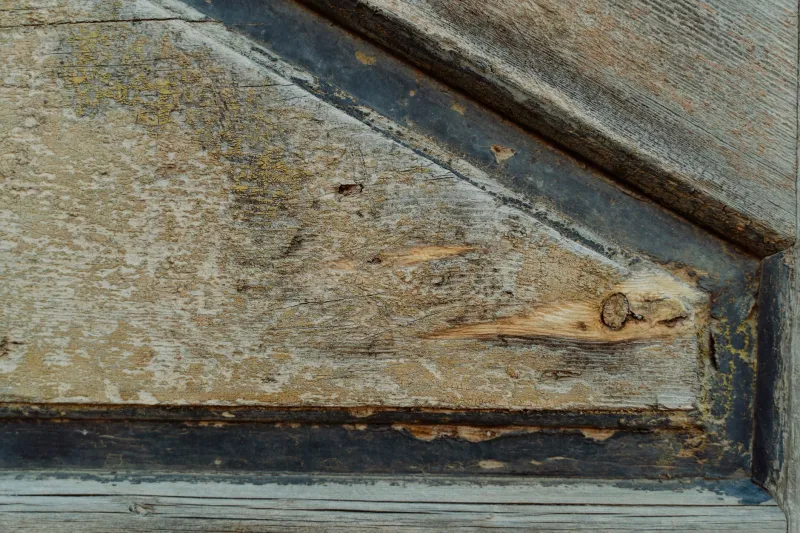
There is a reason the tree is on our masthead. Long before a piece of furniture acquires a maker's stamp, an auction lot number or a story about a country house, it is a stack of timber with a history of its own. Wood records where it grew, how it was sawn, how it was seasoned and how many hands have since intervened. Learning to read those marks is not a shortcut to expertise — but it is the most useful thing a beginner can practise, and it costs nothing but a torch and a magnifying glass.
Start where the tree stopped
End grain is the diary. On a piece of native oak or elm, the rings are visible on a cut edge, and their width tells you about the seasons the tree lived through: wide bands for generous summers, narrow ones for hard years. You can, very roughly, count outward from the heart to the sapwood and arrive at a felling window — but treat it as a smell test, not a certificate. A board may be cut at an angle, the outer rings may be planed away, and timber was often seasoned for years before it became a table.
Two cautions are worth carrying. First, tropical hardwoods such as mahogany frequently show little or no discernible ring pattern, so the absence of rings is not evidence of fakery — it is evidence of geography. Second, the pale sapwood at the edge of a plank is softer and was usually trimmed off by a good cabinetmaker. Finding sapwood on a show surface is unusual, and worth asking why.
The tool leaves a signature
Saw marks date a board better than almost anything else, because nobody bothers to fake them convincingly.
Pit-sawn timber, cut by two men with a long frame saw over a pit, carries irregular, slightly wandering scratches that often taper as the blade drifts. It is slow work, and by the early nineteenth century it was being displaced by machinery. Circular saw marks are the giveaway of the machine age: shallow arcs across the face, like a row of smiles. A band saw leaves a finer, more continuous ripple, and a modern planer or thicknesser leaves almost nothing at all — which is precisely the problem when someone claims a pine dresser is seventeenth century.
Look at the back of a drawer bottom, the underside of a seat rail, the inside of a carcase. That is where the rough work survived, and rough work is where the evidence lives.
Follow the grain across the surface
How a log was cut changes everything you see on the front. Quarter-sawn oak shows those pale, silvery flecks — medullary rays — that make seventeenth-century panelling so distinctive, and it was chosen because it moves less in service. Plain-sawn timber gives you the broad cathedrals and flame figures that Victorian cabinetmakers loved on drawer fronts, book-matched across a pair of doors so the pattern mirrors itself.
Veneer deserves its own paragraph, because it is so often misunderstood. Thin slices of expensive wood laid over a cheaper ground is not a cheat; it is a highly skilled way of using rare timber. Early hand-sawn veneers are noticeably thicker than modern ones, and you can often feel the edge. Cross-banding, stringing and inlay are all period techniques — the question is not whether veneer exists, but whether the thickness, the glue line and the figure look consistent with the rest of the piece.
Joinery is a calendar
Dovetails are the classic party trick, and it is worth knowing that the story is more nuanced than the folklore. Wide, slightly irregular hand-cut pins on early drawers become finer and more uniform as the eighteenth century progresses, and true machine-cut dovetails — evenly spaced, with perfectly symmetrical pins — arrive in the second half of the nineteenth century. Lapped or half-blind dovetails on a drawer front are normal; through-dovetails on a front are a warning sign on anything claiming to be Georgian.
Mortise-and-tenon joints secured with pegs belong to the pre-industrial workshop. Dowels take over later. Screws are a useful clock: slot-headed screws with hand-cut threads point to an earlier date, while Phillips heads are a twentieth-century arrival and should never appear holding an eighteenth-century hinge. Cut nails and wire nails tell a similarly blunt story.
Woodworm, honestly
No subject frightens buyers more, and no subject is more overestimated. Common furniture beetle holes are round, small and generally the work of oak, beech and elm — mahogany, being denser and less appealing, is rarely attacked. What matters is not whether a piece has holes but whether the infestation is live.
Look for pale, gritty frass beneath the piece, and clean it away to see whether it returns. Old holes darken with age and polish, and the surrounding timber often stains; fresh ones have bright, sharp rims. A well-treated nineteenth-century chest with a scatter of historic holes is perfectly sound furniture, and priced accordingly. A chest with fine dust under it in November is a chest you walk away from.
When a repair is part of the story — and when it is the story
An honest repair is one of the most interesting things you can find. A replacement foot carved from matching timber, a spliced leg, a lead patch in a coffer lid, a later stretcher added to stop a chair splaying — these are evidence of a life lived in a house rather than a warehouse. Rural repairs using whatever timber was to hand are particularly good signs, because a faker with a workshop would have done a neater job.
Use a small loupe or a phone torch at a low angle and ask three questions. Is the timber the same species? Does the patina match, or is the repair suspiciously lighter and cleaner? And does the tool work make sense — hand-plane marks on a repair to a hand-cut piece, machine marks where there should be none?
Then there are the red flags. A replacement foot on a high-value piece is a valuation issue, not a crime, but a show-surface repair with a species mismatch is worse. A perfectly matched set of legs on a piece with a rough, mismatched carcase often means two objects have been married. Beware of worm holes in neat rows, of dents clustered where a hand would never fall, and of a patina that is uniformly dark and slightly sticky — walnut stain and a rag can imitate two centuries convincingly in an afternoon.
A pocket checklist
Carry a loupe, a small torch, a soft tape and a magnet. Look at the back before the front. Read the drawer bottoms. Ask what the wood is doing rather than what the seller says it is. Photograph the details you cannot explain and look them up later — the record matters more than the answer.
The tree gets the last word
Provenance is usually written down: a label, a bill of sale, a name in pencil on a drawer. But it is also written in the material, and that record rarely lies, because nobody in 1790 was trying to fool an online bidder in 2026. Learn the grain, the saw, the joint and the mend, and you will find that most pieces tell you where they came from before anyone has opened their mouth to sell them.