The Suitcase Keeps the Receipts: Labels, Straps and a £15 Case Full of Journeys
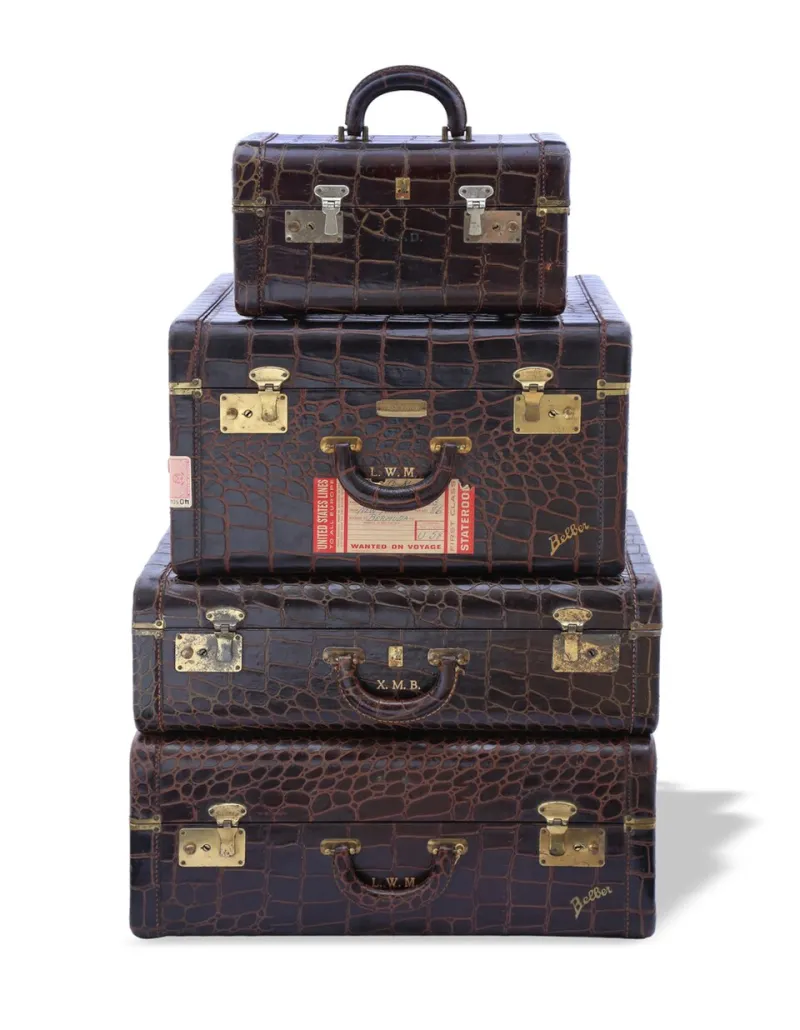
Photo: Sandrine Z, CC BY-SA 4.0, via Wikimedia Commons
There is a particular kind of auction box that smells of someone else's loft: a pyramid of mismatched bricks, one dusty electric fan, three glass ashtrays, and a suitcase. The suitcase never gets its own lot number. It is filler, thrown in because the auctioneer needed something to lean the fan against.
And yet, of everything in that box, the suitcase is usually the only object that has been anywhere.
Labels are a passport with the pages left in
The outside of an old case is a record of movement, glued on one layer at a time. The oldest stickers sit underneath. If you peel back nothing — and you should peel back nothing — you can still read the accumulation from the edge wear and the way later stickers overlap the earlier ones.
Look for four families of label:
- Shipping line labels. Oval or shield-shaped, often in navy and red, with a line name and a route. Union-Castle, Blue Funnel, P&O, Cunard, Ellerman. A Union-Castle label points hard at the Southampton to Cape Town run; a Blue Funnel sticker suggests the Far East trade.
- Railway tags. Ties, paper labels and the punched-card style luggage labels of the big companies, and after nationalisation the regional branding of British Railways. A tag reading 'British Railways' with a region on it is a neat mid-century anchor, given the change in branding that arrived in the 1960s.
- Hotel and airline stickers. Grand hotel labels from the 1930s are miniature posters and are collectable in their own right. Airline stickers place you firmly after the war and, in the case of jet-era branding, after 1960.
- Cabin and 'Wanted on Voyage' labels. Small, often pasted near the handle or on the lid, in cheerful primary colours. These are the ones that make people smile at preview.
A case with three decades of labels on it is telling you its owner travelled repeatedly, probably for work or to visit family overseas, and kept the same case. That is provenance without a single document.
Hardware does the dating work
Ignore the stickers for a moment and look at the fittings. Brass push-button catches with a maker's name stamped into the plate will give you a firm date range. Vulcanised fibre cases — that dense, dark, slightly waxy board — belong largely to the first half of the twentieth century. Pressed fibreboard and later vinyl-covered plywood take over as the century goes on. Nylon zip tape, plastic corner caps and aluminium extrusions all push a case later; leather corners with brass studs push it earlier.
Check the stitching. Even, waxed linen thread in a fine saddle stitch is good work. A thick, clumsy repair with polyester thread is a repair, and often a useful one. Speak to any conservator and they will say the same thing: a well-executed repair is part of the object's life, not a defect.
Handle wear is a signature
Hold the handle and look at it properly. A case carried in one hand for years develops a distinct polish on one side of the grip and a slight thinning at the top of the bend. A handle worn evenly across its width suggests it was carried flat, two fingers through, and possibly not far.
Now look at the corners. Every corner scuff is a floor, a train platform, a stairwell. Look for the tell-tale bloom on leather: the pale, chalky haze that comes from damp storage and dried-out oils. It brushes off. Cracking along the spine of a leather handle does not, and a handle that has been replaced with a strip of webbing is a case that was used until it could not be used any more.
The inside is where the last chapter is written. Lift the lining if it is already loose — never force it. You may find a pressed-paper tray, a tie ribbon, a hotel laundry slip, a baggage sticker with an address, or a name written in fountain pen on a label stitched under the lid. A name turns a suitcase into someone. Take a photograph of it before you do anything else.
The smell question
Old cases hold odours like a closed room. Camphor and mothballs are harmless and will fade with airing. Mildew is a project: it means spores in the lining, and no amount of bicarbonate of soda will fix a case that has been damp for a decade. If the base feels soft or the fibre has delaminated, walk on. A suitcase is only worth saving if it can still hold a shape.
Should you carry it home?
For fifteen pounds, a labelled case is fair value as a display piece, a storage box for blankets, or a bit of set dressing in a hallway — and considerably more if the stickers are good. Two cautions. First, do not put it back into airline service: old locks fail, and old hinges fail at the worst possible moment. Second, if there is any ivory fitting or inlay on an older case, remember that the UK's Ivory Act 2018 restricts dealing in ivory items, with narrow exemptions, so check before you buy to resell.
Finally, resist the urge to tidy. Those overlapping stickers, faded in the sun on one side and bright on the other, are the whole point. Anybody can buy a new case. Only this one has been to Mombasa and back, and it kept the receipts.