The Darning Mushroom’s Diary: Unpicking a Fifteen-Pound Sewing Box
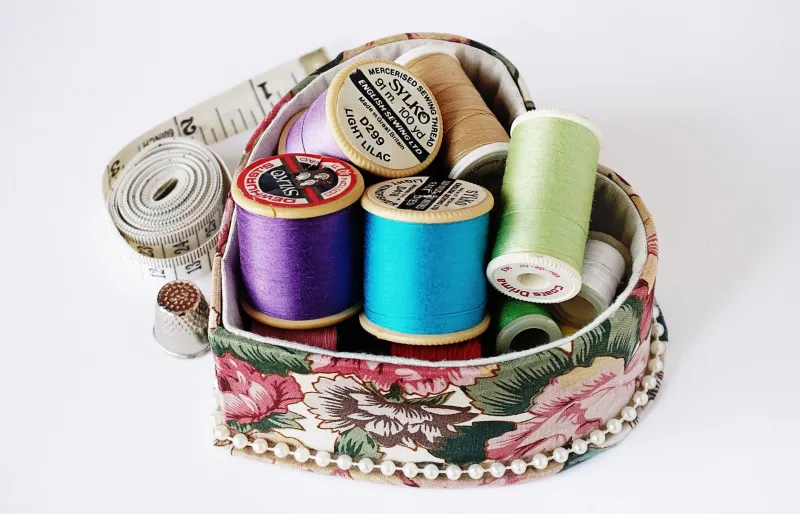
At a provincial saleroom last month, a mahogany-veneered sewing box came up in the tail end of a house clearance. The lid was scratched, the lock was missing and the auctioneer described it, accurately enough, as ‘a box of sewing items’. It made fifteen pounds. Somebody in the room got a bargain. Somebody else, perhaps, got a small archive of ordinary life.
Sewing boxes are easy to overlook because they look like clutter. They sit between the proper antiques and the box-lot debris, usually with a bundle of odd cotton reels and a few rusting needles inside. But open one carefully and the contents start to speak. Not in a grand, documented-provenance way — more in the way of a kitchen drawer that has quietly recorded forty years of family repairs.
First, Ignore the Lid
The outside of a sewing box is the least interesting part. Yes, the veneer can tell you whether it is Victorian, Edwardian or a later reproduction. Yes, the hinges and the lock can hint at date and quality. But the real evidence is usually inside: the lining, the tray, the pin cushion and the small objects that have been allowed to stay.
Look at the base of the box before you touch anything. A worn patch in the centre suggests it was carried often. A ring mark might mean a pot of something stood there. Crumbs of dried thread, tiny pin holes in the lining and a faint dusting of rust are not flaws to be cleaned away in a hurry. They are the box doing its job.
The Thimble Remembers
A thimble is one of the most personal things in a sewing box. It is also one of the most useful for dating. The wear pattern matters. A thimble worn smooth at the top has been used for pushing needles through heavy fabric. One worn at the side suggests a different grip, perhaps a left-handed sewer, perhaps someone who worked at a particular angle.
Material helps too. Brass, silver, steel and later aluminium all point in different directions. A silver thimble with a maker’s mark can be dated closely; a plain steel one is more of a broad hint. But even a humble thimble can tell you whether the box was used for fine work or hard graft. Put it under a lamp and look at the dimples. If they are almost gone, that thimble earned its keep.
A Mushroom With a History
The darning mushroom is the quiet hero of many old sewing boxes. This rounded wooden tool was pushed into a sock or a sleeve to hold the fabric taut while a hole was darned. The best ones have a stem worn smooth by hands and a cap darkened by years of contact with wool and cotton.
A mushroom is also a useful social clue. It suggests mending rather than dressmaking — practical household repair, not ambitious fashion. If it sits alongside a packet of darning wool and a pair of small scissors, you are probably looking at a box that belonged to someone who kept a household running. That is not a lesser story. It is often a more revealing one.
Buttonhooks, Bobbins and the Small Change of Domestic Life
Old sewing boxes often contain a jumble of small tools that seem unrelated until you imagine them in use. A buttonhook for boots and gloves. A bodkin for threading ribbon. A tracing wheel. A tiny stiletto for eyelets. A bobbin or two, perhaps from a machine that has long since gone.
Do not assume every item began life in that box. Sewing boxes were practical storage, and practical storage collects things. A buttonhook may have been dropped in after the boots went out of fashion. A packet of needles may be later than the box itself. That is normal. The trick is to separate the objects that belong together from the ones that simply ended up there.
Look for repeats. Three thimbles in different sizes suggest a household with several pairs of hands. A single thimble, a mushroom and a small tin of pins suggest one person’s routine. Neither is better. They are different kinds of evidence.
Paper Patterns and the Ghost of a Wardrobe
Paper patterns are often folded into the lid or tucked under the tray. They are fragile, easily discarded and disproportionately revealing. A pattern for a child’s smock, a utility dress or a man’s shirt can date a box within a decade or so. The illustrations, the sizing and the price printed on the envelope all help.
Do not unfold a brittle pattern on the saleroom table. Wait until you are home, clear a surface and use clean hands. If it is torn, photograph it before you try to flatten it. The pattern itself may be ordinary, but the fact that someone kept it is not. It suggests the box was used for making and altering clothes, not just for running repairs.
Fabric Scraps as a Date Stamp
A handful of fabric scraps can be surprisingly eloquent. A piece of paisley, a scrap of blackout lining, a offcut of nylon or a faded floral print all sit in different periods. If the scraps match the lining of the box, they may be original. If they are completely unrelated, they may be the last things someone meant to use and never did.
Smell the box, too, but gently. Old sewing boxes often carry a mix of machine oil, lavender bags, dusty wool and tobacco. A strong smell of cedar or camphor might mean the box was stored with moth protection. None of this is definitive, but it all adds texture.
What to Pay and When to Walk
Fifteen pounds is a sensible price for a modest box with honest contents. Thirty pounds is still reasonable if the box is sound and the contents are coherent. Beyond that, you need a reason: a named maker, a rare tool, a particularly good thimble or a paper trail that connects the box to a person or place.
Walk away if the box has been heavily ‘styled’ with unrelated contents, if the lining has been replaced with modern fabric, or if the seller cannot resist telling you it belonged to a Victorian seamstress without a shred of evidence. A good sewing box does not need a story invented for it. It already has one.
The Box as a Biography
The best fifteen-pound lots are not the ones with the most objects. They are the ones where the objects agree with each other. A worn thimble, a darning mushroom, a folded pattern and a few scraps of cloth can add up to a portrait of a person who mended, made do and kept going. That is not sentimental. It is simply what the evidence suggests.
So next time a shabby sewing box comes up near the end of a sale, do not dismiss it as a box of odds and ends. Open the lid, look at the wear and ask what the contents were kept for. The answer is often more interesting than the box itself — and considerably cheaper than a portrait.