The Saucerless Six: What Odd Cups and Backstamps Reveal About a Victorian Kitchen
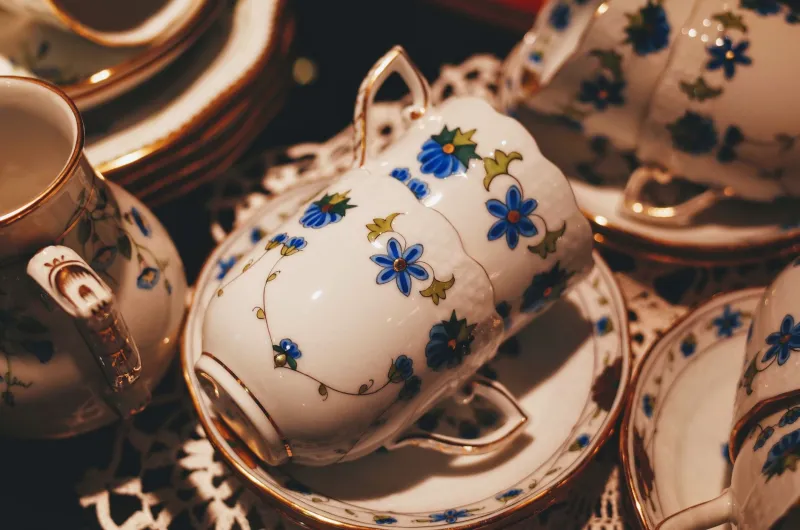
The box was not promising. Six cups, no saucers, one plate with a hairline, and a sugar bowl that had clearly been someone's pen pot since about 1974. The lot sticker said eight pounds, which felt about right for a rainy Saturday morning in a UK saleroom. But once the cups were unpacked and lined up on the kitchen table, the little pile stopped looking like rubble and started looking like evidence.
Mismatched tea services are some of the most underrated things you can buy at auction. Not because every odd cup is valuable — most are not — but because they are honest. A full service tells you what a manufacturer wanted a household to own. A box of odds and ends tells you what a household actually did.
The Victorian tea table was often a patchwork
It is tempting to imagine every Victorian dresser groaning under a perfectly matched tea service, each cup and saucer reunited like a happy family. In reality, tea things led messier lives. Cups broke. Saucers chipped. A favourite pattern was discontinued. A daughter married and took part of a set with her. A servant dropped the best jug. Replacements were bought when money allowed, and they did not always match.
By the later Victorian period, cheapish decorated china was widely available through drapers, china shops, catalogues and markets. Households could add a cup here and a plate there without commissioning a whole service. That is one reason a single auction box can contain half a dozen different backstamps, three different rim patterns and a plate that looks as if it wandered in from another century entirely.
So when you find six cups with no saucers, do not immediately mourn the missing pieces. Ask what the absence tells you. Were the saucers kept because they were useful under other cups? Did the cups survive because they were used for everyday tea while the best service stayed in the parlour cabinet? Or did the lot simply get split by a house clearer who had no interest in reuniting anything?
Start with the backstamp, not the pattern
The mark underneath is usually the quickest way into a piece of china. Turn the cup over and look at the base before you fall in love with the flowers on the front.
A few beginner-friendly clues are worth knowing:
- Impressed marks were pressed into the clay before glazing. They are often faint, but they can give a maker's name or a date code.
- Printed marks became common in the 19th century and are usually easier to read. Look for a maker's name, a trade name, a country of origin or a pattern number.
- Registration diamonds appear on some British designs registered between 1842 and 1883. The diamond contains coded information about the design's registration date.
- 'England' on the mark is a useful later clue. From 1891, goods entering the United States had to be marked with their country of origin, and British makers increasingly used 'England' on wares meant for export. It is not a perfect dating tool on its own, but it usually pushes a piece towards the late Victorian or Edwardian period rather than the early Victorian.
- 'Made in England' generally points to the 20th century.
None of this is a substitute for proper reference books or a specialist's eye, but it is enough to stop you assuming that every floral cup is 'Victorian'. A lot of pretty china sold as Victorian is Edwardian, 1920s or later. That does not make it worthless; it just makes it a different story.
Pattern numbers and the pleasures of near-matches
Pattern numbers can be surprisingly useful. A cup marked with a number and a maker's name may be traceable through old catalogues, collector forums or museum databases. Even when you cannot pin down the exact pattern, the number tells you that the piece belonged to a production system — a design that was made in runs, sold in sets and replaced piece by piece.
This is where mismatched china becomes more interesting than a perfect service. A near-match can show you how a household adapted. Perhaps the cups are one pattern and the plate is another, but the gilding is similar enough that someone once used them together. Perhaps a cup has a different handle shape from its fellows because it was bought later as a replacement. These small inconsistencies are not flaws in the story; they are the story.
Crazing, chips and the question of a fiver
Condition matters, but not always in the way beginners expect. Crazing — the fine network of cracks in the glaze — is common on old china and is not automatically a reason to walk away. It can be caused by age, heat, washing or the glaze and body expanding at different rates. The real concern is staining or dirt that has worked into the crazing, and whether the piece feels unstable or smells musty.
Chips and hairlines are more serious. A small nibble on the foot rim of a cup you intend to display is one thing. A hairline running down from the rim is another, especially if the cup is meant to hold liquid. Hold the piece up to the light, run a fingernail gently around the rim and look closely at the handle joins. Hairlines often hide there.
So what is worth a fiver? My own rule is simple: buy the oddments that teach you something or give you pleasure. A cup with a clear maker's mark, an intact handle and a pattern you like is worth a few pounds as a study piece. A saucerless cup with a badly stained interior and a repaired handle is probably a skip candidate unless the mark is genuinely rare. A plate with a hairline can still be useful for display, but do not pay 'best china' money for it.
The dresser defence
There is a particular kind of nostalgia attached to a dresser stacked with unmatched china. It speaks of practicality rather than perfection: the cup that survived because it was always used, the saucer that came from somewhere else, the plate that does not quite belong. It is a visual record of small economies and daily habits.
That is why the saucerless six came home. They are not a set, and they never will be. But line them up on a shelf and they do something a pristine service cannot: they make you wonder who drank from them, what was replaced and why. For eight pounds, that is a decent return on a rainy Saturday.
If you spot a similar box at your local saleroom, take a loupe, a torch and a little patience. Check the marks, feel the rims, and do not be frightened by a bit of crazing. The odd cups are often the ones with the most to say.