Beech, Brass and Bearing Witness: Inside a Thirty-Pound Toolbox
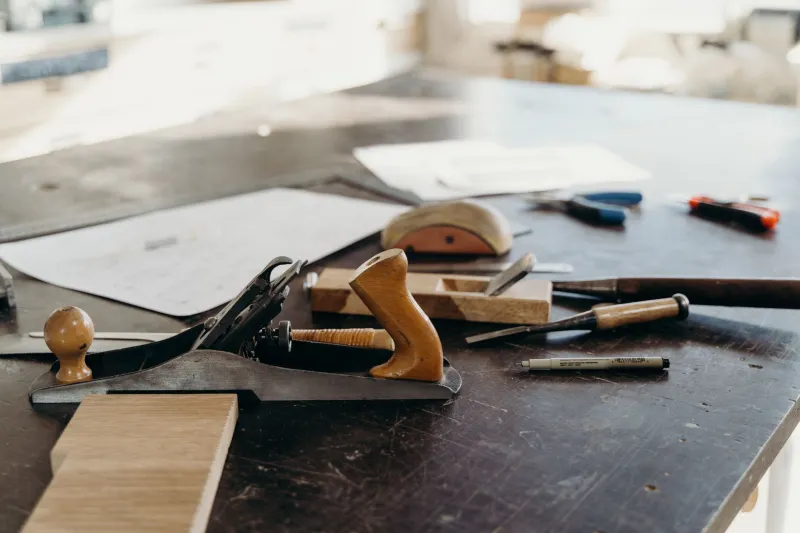
At a Tuesday sale in a draughty village hall, the box lot is almost invisible under a trestle table: a carpenter’s wooden tote, a rusted brace, three chisels with mismatched handles and a plane whose iron is black with age. The auctioneer wants £30. There is no label, no receipt, no letter from a grateful grandson. Yet the box is full of evidence. For a beginner, old hand tools are one of the cheapest ways into provenance: not the paper kind, but the human kind, written into beech and steel.
Start with the handles, not the maker
A tool handle is where a person met an object, day after day. Look first at the high points: the bulge where a palm rested, the worn rim near a ferrule, the darkening around a tang. Beech goes buttery; ash keeps a coarser grain; rosewood polishes to a slick shine. A handle that is smooth but stained is not neglected — it has been used. A handle that is pristine on a 100-year-old chisel is probably a replacement.
Repairs are not a defect in the story; they are the story. A split handle held with a brass plate, a dowel through the neck, a ferrule replaced with copper pipe — these are workshop solutions, and they suggest a tool that mattered enough to fix. What you want to avoid is a repair that has failed. A split running clean through the tang, or a handle that rocks on the socket, may be beyond a beginner’s glue-up. A crack that has been glued and then worn smooth again is usually sound.
Set dents tell you how the tool was driven. Chisel handles show a constellation of small bruises at the butt where a mallet landed; a carved mallet itself may have a worn face. A plane’s rear handle can carry dents from being tapped to release the iron. These marks are not pretty, but they are specific. They say: this was a working tool, not a decoration.
Maker stamps and the geography of a toolbox
Turn the iron over. A stamp such as Marples, Sorby, Stanley, Record, Preston or Norris places the tool in a British tradition, though not necessarily a precise date. Look at how crisp the stamp is, whether it is over-stamped, and whether the iron matches the plane body. A mismatched iron is common — blades were swapped, sharpened away and replaced. That is not a reason to walk away, but it is a reason to pay less.
A box with several Sheffield names might suggest a workshop in the industrial north, or simply a dealer’s mixed lot assembled from house clearances. Resist the urge to invent a biography. Use the tools to triangulate, not to fantasy. If a saw has an owner’s stamp — initials punched into the handle, a paper label inside the tote — you have a thread to pull. A name and a town can be researched. A maker’s stamp plus a repair style plus a set of sharpening habits gives you a plausible picture, not a certified one. That is the honest pleasure of tool provenance.
Sharpening marks: the diary in steel
The edge is where the owner’s habits show. A wide, even bevel with a hollow grind suggests someone who used a grinder and honed carefully. An irregular bevel, polished by hand, suggests freehand sharpening on a stone. A pronounced camber — a curved edge — belongs to a scrub plane or a heavy fore plane; a narrow, straight edge belongs to a smoother or a paring chisel.
Look at the scratches. They run in the direction of the honing stroke. Look at the corners: a chisel sharpened thousands of times often loses its square corners and becomes slightly rounded. A blade that has been ground back to a short stub has lived a long life. A blade with deep pitting right at the cutting edge is a project, not a bargain. Rust elsewhere can be surface; rust at the edge is the part that matters.
Rust, splits and missing bits: practical buying notes
In a UK saleroom, damp is the enemy. Surface rust on a plane body is usually cosmetic and can be dealt with using wire wool and oil, but deep pitting on the sole or the iron is not. Ask to handle the lot. Check that the plane’s cap iron, lever cap and adjuster are present; a missing lever cap can cost more than the plane. A brace without bits is cheap for a reason — good bits are not. A saw with missing nuts or a split handle can be repaired, but check the teeth: if they are filed down to nubs, it is a wall ornament.
Split handles are common and not automatically fatal. A hairline crack along the grain can be glued and clamped. A chunk missing at the socket is harder. For chisels, check the ferrule and the socket or tang; a loose handle can be re-seated with a new wedge. For a £30 box, aim for two or three usable tools, not a museum set. Budget for consumables — oil, wire wool, a decent stone — and you will still be ahead of buying new.
What a toolbox can tell you without paperwork
The best provenance in a toolbox is cross-reference. A wooden tote with a name burned into the side, a saw sharpened left-handed, a chisel ground at an unusual angle, a repair using a copper patch: these details add up. A mixed box with a cobbling hammer, a saddler’s awl and a carpenter’s plane probably belonged to a household rather than a single trade. A box with three sizes of the same maker’s chisel and a neat, repeated sharpening style looks like one person’s kit.
You will not get a certificate. You will get a Saturday afternoon with an oily rag and a growing sense of who used the thing. That is provenance of a sort — the sort that doesn’t need a folder.
A thirty-pound story
So yes, buy the box. Check the handles, the stamps, the edge, the rust and the missing bits. Pay £30 if there are two good tools inside, £20 if there is one and a story. Clean gently, keep the labels, and don’t sand away the dents. In November 2026, with salerooms full of mixed lots, the cheapest way to own a piece of working history is still a cardboard box under a trestle table. The hands that wore the handles left their evidence. You just have to read it.