Screws, Shadows and the Odd Brass: What a Mismatched Knob Tells You Before the Hammer Falls
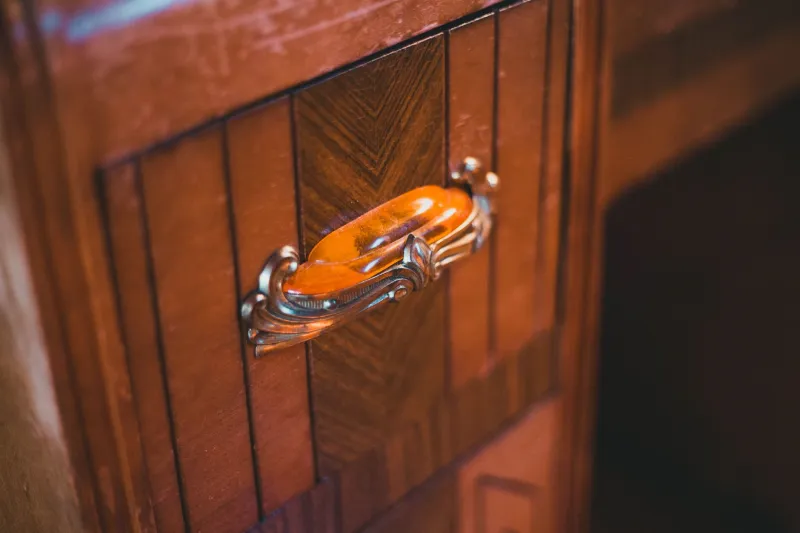
There is a particular kind of auction chest that turns up again and again in provincial salerooms: mahogany-veneer front, pine carcass, a bit of scuffing around the feet, and a guide price that barely covers a round of drinks. This one had a £35 estimate and six drawers, five of which wore neat little brass knobs. The sixth had something else entirely — a plain wooden pull, slightly too large, sitting a fraction off-centre. From three feet away it read as a flaw. From one foot away it read as a biography.
Mismatched hardware is one of the most useful things you can learn to look at on cheap furniture. Not because every odd knob is a secret treasure map, but because knobs, escutcheons, hinges and handles leave physical evidence. They record repairs, removals, changing fashions and the ordinary business of living with a piece of furniture for a very long time. A perfect matching set might simply mean someone has been busy with a screwdriver and a tin of Brasso. A mismatched one often means nobody has.
Start with the shadow, not the knob
The first thing to do at a viewing is to ignore the handle itself and look at the wood around it. A knob that has sat in the same place for decades will usually leave a halo: a patch of less-faded timber, a faint ring of compressed grain, or a tidemark where polish has built up and then been rubbed away. If the current knob sits inside that ghost, it is probably original or a like-for-like replacement. If it sits beside the ghost, someone has moved it. If there is a ghost with no knob at all, the piece has lost a handle and gained a story.
On the £35 chest, the wooden pull sat about half an inch to the left of a clear circular shadow. Underneath the shadow was a small filled hole, darkened but not disguised. That is not incompetence; that is economics. Somebody, probably decades ago, lost or broke a brass knob and made do. The replacement was close enough to hand, the old hole was plugged, and life carried on. In provenance terms, that is far more interesting than a set of shiny reproductions bought online last week.
The spare hole is a date stamp
Look closely at the back of a drawer front and you will often find more holes than handles. Old furniture was frequently re-fitted: brass in the Georgian style gave way to wooden knobs in leaner times, then back to brass when tastes changed again. Each swap leaves a scar. A single filled hole behind a current fixing suggests one replacement. A cluster of holes, some plugged with dowel and some simply left open, suggests a longer conversation between the piece and its owners.
This is where a cheap lot becomes genuinely useful for a hobbyist. You do not need a maker's label to date a drawer pull roughly. The shape of the screw holes tells you about the screws themselves — slotted rather than Phillips, often hand-cut and slightly irregular on older work. The spacing tells you whether the current handle was made for the existing holes or whether the holes were made to fit the handle. And the type of metal tells you plenty: solid brass that has gone dark and slightly pitted, stamped thin brass that dents under a thumb, or early plastics such as Bakelite with their moulded seams and unmistakable warm brown-black colour.
Honest wear versus clumsy repair
The tricky part is telling a lived-in mismatch from a rushed restoration. The distinction usually comes down to three things: consistency, tool marks and the direction of the damage.
Honest wear is consistent with use. A drop-front desk might have a worn patch where a hand regularly lifted the flap; a chest might have darker knobs on the lower drawers because they were touched more often. Clumsy repair tends to be local and slightly out of rhythm. Fresh screw heads in old holes, a handle sitting proud of the wood because the recess was never cut, or a replacement knob that is visually correct but a fraction too small to cover the old shadow — these are the telltale signs of a quick fix rather than decades of gentle decline.
Tool marks are useful too. A neatly plugged hole with a matching grain plug suggests a careful carpenter. A hole filled with coloured wax or simply left open suggests a household repair. Neither is automatically bad. On a £35 chest, the wax-filled hole is part of the charm. On a £350 chest, you might want to know why the restoration stopped there.
What the metal itself can tell you
UK auction lots are full of brass, and brass ages in a very particular way. Old brass develops a patina that is uneven and slightly soft-looking, with darker recesses and polished high points. Reproduction brass often has a uniform, thin coating that wears through quickly to a pinkish tone. If the mismatched knob on your chest is a different alloy from the rest, hold it up to the light. A subtle difference in colour is common in old replacements, because brass varies by batch and supplier. A glaring difference — one knob bright yellow, the others a dull chocolate brown — is more likely to be a modern swap.
Then there are the backplates. Many Victorian and Edwardian drawers had decorative brass plates behind the knob, often stamped with a pattern. If the plate is missing on one drawer but the outline remains in the polish, you have a clear record of loss. If the plate is present but the screw holes do not line up with the shadows behind it, the plate has been moved from another piece — or the drawer has. Either way, it is worth a second look.
The bidding question
So what do you do with all this at the fall of the hammer? The honest answer is that most mismatched hardware does not add value in the saleroom. It adds information. It tells you the piece has been used, repaired and kept, rather than stripped and refinished for sale. For a hobbyist buying at the cheaper end, that is often a recommendation rather than a warning.
Before you bid, ask yourself a few practical questions. Are the mismatches stable, or is the drawer front splitting around the screw holes? Do the drawers still run smoothly, or has a replacement handle been fitted so tightly that the front is pulled out of shape? Is the odd knob merely different, or is it actively damaging the wood? If the answer to the last question is no, you are probably looking at honest history rather than a problem.
The £35 chest sold, as these things do, for a little over estimate. I did not buy it. I did, however, photograph the ghost handle and the filled hole, because they told me more about the piece than the auctioneer's description ever could. Somewhere in its past, someone lost a brass knob and found a wooden one. That is not a flaw in the lot. It is the lot's best paragraph.