The Lonely Chair Defence: Why Auction Singles Deserve Your Tenner
I have nothing against a matching dining set. It is tidy, it is sensible, and it tells guests exactly what kind of household you run. But give me the lonely chair every time: the one propped against a wall in the saleroom, photographed badly, listed as ‘single chair, mahogany’. It is usually the most interesting thing in the room, and often the cheapest.
The set is the enemy of a good room
A full suite of six identical chairs is furniture by the metre. It can look handsome in a formal dining room, but in most British homes it looks like a hotel breakfast room waiting for a conference. Odd chairs bring rhythm. They suggest a room that has been lived in, added to, and edited — not ordered from a catalogue.
At auction, sets are bid up because dealers want them and homeowners think they need them. Singles slip through. In a general household sale in 2026, a decent Victorian balloon-back might make £15–£30; a good 1950s dining chair, £10–£25; a solid mahogany carver with a bit of presence, £30–£45. Compare that with a matched set at £150–£300, plus the van hire and the argument about whether you really need six. The lonely chair is the bargain.
Why singles are cheap — and why that is your gain
A single chair is awkward to sell. It does not furnish a table. It cannot be photographed as a lifestyle. It is often at the end of the sale, when the room has thinned out. That is exactly where you want to be. One good chair can be a desk chair, a bedroom chair, a hall chair, a plant stand with pretensions, or the extra seat that stops a dinner party feeling like a board meeting.
The trick is not to buy any old orphan. It is to buy a good one. That means checking the things a photograph will never show you.
The three-minute check: joints, frame, seat drop
Turn the chair upside down. This is not a metaphor. Look at the joints: are the legs tight in the seat rails? A little movement is common; a lot is a project. Old repairs are fine if they are sound — a glued block, a metal plate, a replaced screw. Fresh white glue squeeze is a warning that someone has tried to fix a wobble in a hurry.
Check the frame for splits, especially at the back legs and where the crest rail meets the stiles. Press the seat. If it crunch-crunches, the upholstery is tired. A drop-in seat is easy to re-cover; a stuff-over seat is a bigger job. Check the seat drop — the height from floor to seat — and the sag. Dining chairs usually sit around 45–48cm. If a chair has been cut down, it will feel wrong at the table. If it sags, budget for webbing or foam.
Also look for woodworm. Old flight holes are common and often historic; fresh frass means active beetle. In a damp UK saleroom, give any suspicious chair a miss unless it is very cheap and very lovely.
Mixing eras without jumble sale energy
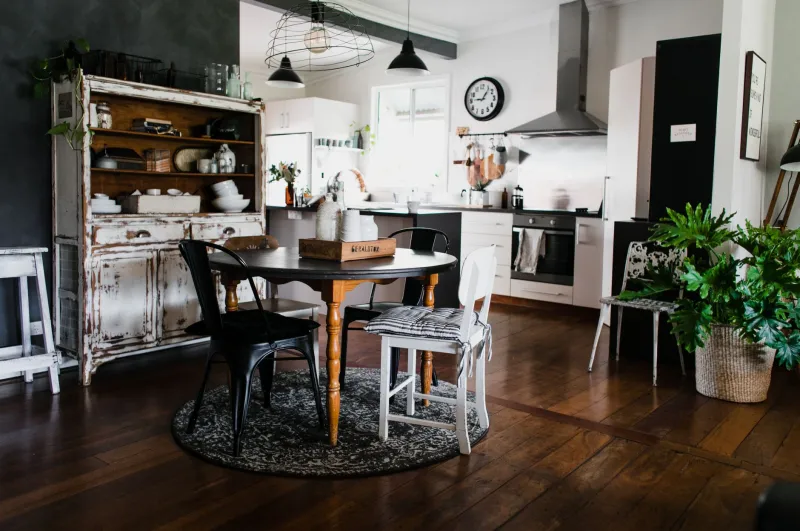
The secret to mixing odd chairs is a common denominator. It might be wood tone, seat height, or silhouette. A set of three mismatched wooden chairs around a scrubbed pine table can look deliberate if they share a warm brown tone and a similar back height. Add a painted chair and it can look like a jumble sale. Add a chrome-and-vinyl number and it can look like a student flat.
My rule is one odd chair per room, two at most. Let the dining table have a pair of matching chairs at either end and singles along the sides, or use a single as a desk chair where it does not have to compete. Repeat a material before you repeat a period. Three dark wood chairs from different centuries will usually sit together more happily than three chairs from the same decade in three different colours.
Spotting a genuinely good lonely chair
Good chairs have good bones. Look for a solid seat rail, legs that are thick enough to take a knock, and a back that has not been broken and badly repaired. Check the feet: worn feet mean genuine use, not necessarily neglect. Look underneath for maker’s labels, stamps or stencils — not to add value, but to add interest. A chair with a label from a provincial maker is a small piece of local history.
Avoid the ‘antique’ pine chair with fake distress and a price tag that belongs in a boutique. Avoid anything with a replaced leg that does not match the timber. And avoid the chair that looks perfect but rocks like a pub table. A wobble can be fixed; a chair with a twisted frame usually cannot.
Auction tactics for 2026
Set a limit before you bid, including buyer’s premium and the cost of getting it home. Ask for a condition report if you cannot view in person, and read the collection dates. Online bidding has made it easy to pay over the odds for a lonely chair at 11pm, so decide your maximum while you are still sober and sensible.
Singles often appear in general sales rather than specialist furniture auctions. Look at the last few lots. They are the ones people miss. If you see two singles of the same shape, buy both — a pair is easier to place than one, and still cheaper than a set.
The case for the odd chair
A matching suite is furniture. A mix of good singles is a room with a pulse. Buy the chair that looks as if it has been sat in, not the one that looks as if it has been staged. Pay your tenner, carry it home, give it a wipe and a new seat pad if it needs one. In 2026, with so many salerooms full of overlooked singles, the best chair in the room is often the one standing on its own.