Bowl Hollows and Handle Shadows: A Buyer’s Field Guide to Twenty-Pound Treen Lots
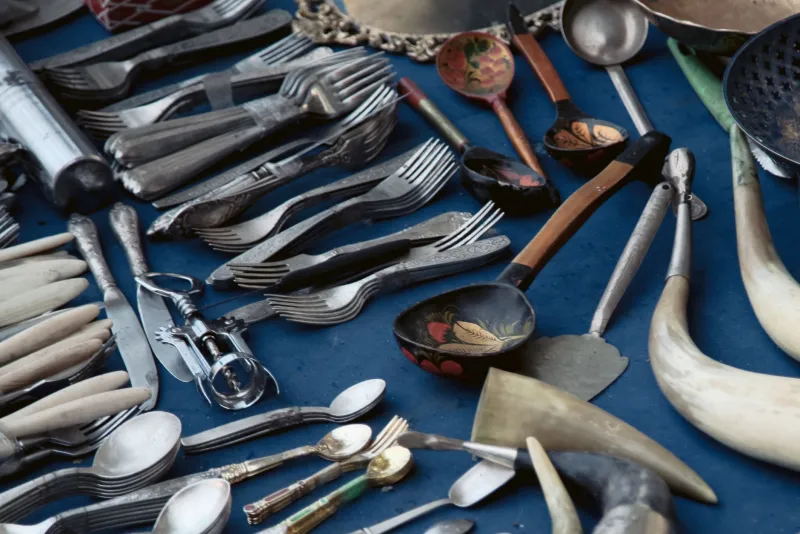
There is a particular sort of auction lot that rarely makes the catalogue’s front page: a cardboard box, an elastic band, and half a dozen wooden spoons clattering together like a cutlery drawer in a hurry. The estimate says £20, the description says ‘quantity of treen’, and most bidders walk straight past. That is a mistake, or at least an opportunity. Treen — the old catch-all for wooden domestic items — is one of the most honest things you can buy at a UK saleroom. It was made to be used, it carries the marks of that use, and it rarely pretends to be grander than it is.
A bundle of spoons, spatulas, butter paddles and perhaps a rolling pin is also a small archive of a household’s cooking habits. Before you dismiss the lot as firewood with a story, pick it up at the preview and look properly. The clues are not hidden in a hallmark or a paper label. They are in the bowl, the handle, the grain and the grime.
First, Pick Them Up — and Put Them Down
Viewing is everything with treen. Photographs flatter shape and hide cracks, and auction house condition reports are necessarily brief when a lot contains eight separate objects. At the preview, ask if you can handle the pieces. Most salerooms are happy for you to do so, provided you are careful and do not start testing them like drumsticks.
Take each spoon out of the box. Turn it over. Look along the bowl from the side, then down the handle from the end. Check the rim for splinters and the bowl for a hairline that runs with the grain. Give the handle a gentle flex — very gentle — to see whether a crack opens. Look for fresh woodworm frass under the box, not just old flight holes in the wood. And use your eyes rather than a damp cloth: cleaning a dry piece at the preview is a quick way to make yourself unpopular.
The Bowl Is a Map of Use
The bowl of an old wooden spoon is where the cooking happened. A serving spoon develops a smooth, polished hollow and a rim worn thin on one side. A stirring spoon often shows a deeper hollow and scrape marks where it has been dragged around a pan. A spoon used for straining or skimming may have a shallower bowl and a longer handle. None of this is an exact science, but the pattern of wear is usually more persuasive than the shape alone.
Look for the difference between wear and damage. A bowl that has been scraped thin at the rim by years of contact with a pot is telling you something. A bowl with a fresh gouge and splintered edge is telling you to check the price. Also look at the inside of the bowl under raking light. Hand-carved spoons often show faint facets or a slightly uneven surface where the knife has cut across the grain. Machine-turned pieces tend to show regular concentric rings and a more uniform thickness.
Handle Stains, Patina and the Honest Grime
A dark handle is not necessarily dirty; it is often the result of hand oils, smoke, heat and time. The area where a thumb has rested for decades can be noticeably smoother and darker than the rest. Staining around the bowl may come from tannin, grease, dye or simply the contents of a stockpot. These marks are part of the object’s history, and they are one reason not to attack old treen with sandpaper and a determined expression.
That said, not all patina is equal. A sticky, uniform brown coating may be old varnish or a later polish rather than honest wear. A pale patch on an otherwise dark handle can suggest a repair or a replaced section. Ring marks on a rolling pin or butter paddle are usually heat or water marks, not a maker’s signature. Treat every stain as a clue, but do not build a whole family history around a splash of gravy.
Tool Marks: Knife, Adze and Lathe
Hand-carved treen has a different rhythm from factory work. A knife leaves facets; an adze or gouge can leave shallow scoops; a hand-cut handle may be slightly eccentric. You might see stop marks where the carver changed direction, or a small flat where the wood was held. Machine-turned pieces are more regular: crisp concentric rings, even wall thickness, a handle that feels almost too symmetrical. Neither is automatically better, but the distinction affects what you are buying. A later machine-made spoon can be a useful kitchen tool; an older hand-carved one is a small piece of craft history.
Collectors sometimes talk about regional traits — long-handled pot spoons in some northern kitchens, broad serving paddles in the west, dairy spoons associated with particular farming areas. Treat these as clues rather than certificates. Wooden kitchen implements travelled, were copied and were made in workshops that supplied more than one county. The grain, tool marks and wear will tell you more than a hopeful guess about the maker’s village.
Cracks, Repairs and the Question of Worth
A crack running along the grain of a dry spoon is common and often stable. A crack running across the grain, especially near the bowl or where the handle meets the bowl, is more concerning. Old repairs can be perfectly sound: a dark glue line, a metal band, a rivet, a wooden patch or a staple. An honest repair is part of the object’s life, but it should be reflected in what you pay. If the lot is being sold as decorative treen, a stable repair may be fine. If you want a user, test it carefully and be prepared to retire it.
Woodworm is the other classic worry. Old flight holes are not automatically a reason to walk away, but fresh frass and crumbling wood are. Check the box, the newspaper wrapping and the darker corners of each piece. And remember that a £20 bundle can contain one good spoon and several tired ones. That is not necessarily a bad lot — just price it as one good spoon plus a box of useful extras.
The Mismatch Equation
A mismatched bundle is where treen gets interesting. You might find a hand-carved serving spoon, a later beech spatula, a sycamore butter paddle and a rolling pin that has lost its handles. The value is rarely in the whole lot. It is in the one piece that makes you look twice. Work out your maximum bid before the auction starts, then add the buyer’s premium and VAT so the £20 estimate does not become a £30 surprise. Set a limit and stick to it. The charm of treen is that it rewards curiosity, not competitiveness.
A Saleroom Checklist for 2026
- View in person if you can, and handle every piece.
- Count the objects and identify the one you actually want.
- Look along the bowl and down the handle for cracks and repairs.
- Check for fresh woodworm frass, rot and loose joints.
- Compare hand-carved facets with machine-turned regularity.
- Photograph any marks or labels before you bid.
- Ask the saleroom about condition, provenance or any later additions.
- Set your all-in limit before the hammer falls.
A twenty-pound bundle of treen will not make you rich. It might, however, give you a spoon that has stirred more Christmases than you have, a spatula with a handle worn into a thumb-shaped hollow, or a butter paddle that still smells faintly of the dairy. Rooted in history and found at auction, these are the lots that reward a slow look. Put the box down gently, pick the best piece up, and let the bowl do the talking.