Dull Shine, Honest History: How to Read a Silverplate Tray Before You Reach for the Polish
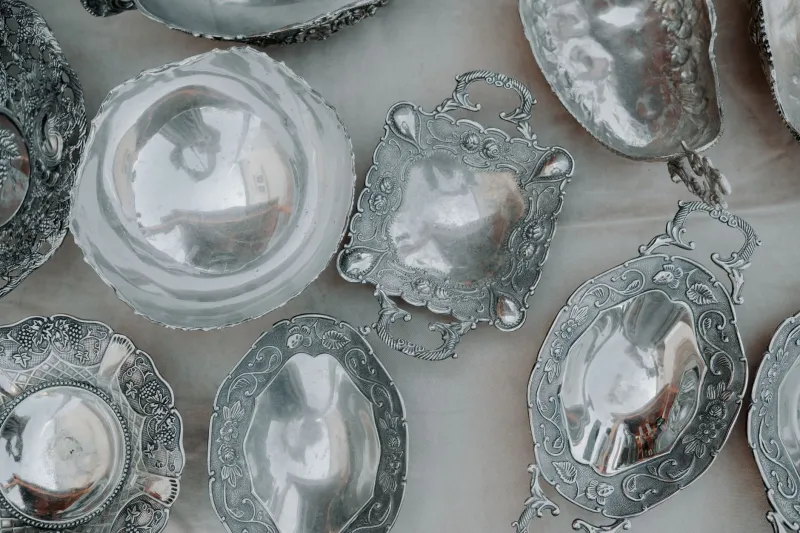
There is a particular sort of auction tray that turns up in November salerooms: oval, slightly loose on one foot, engraved within an inch of its life, and wearing a complexion somewhere between gunmetal and gloom. It sits on a trestle table with a £20–£30 estimate and a label that says ‘silver plated tray’. Most bidders walk past. That is usually a mistake — but not always. The trick is learning to read the tray before the polish comes out.
At Antiques Tree, we are firm believers that the dullest lot in the room often has the most to say. Silverplate is not sterling silver, and it never will be. It is a thin layer of silver deposited or fused onto a base metal, usually nickel silver, copper or brass. That means its condition is a story of use, cleaning and occasional mishap. Read it properly and a twenty-pound tray can tell you more about the last century than a gleaming showpiece ever could.
Start With the Dullness, Not the Shine
Tarnish is not dirt. On silver and silverplate it is mostly silver sulphide, a dark film that builds up when the metal meets sulphur compounds in the air, in wool, in rubber bands and in the atmosphere of a damp British storeroom. A tray that is uniformly dark has often been left alone, which is good. A tray with bright patches where hands have gripped it and black shadows in the recesses has been used, handled and probably loved.
That pattern is your first map. Look at the high points: the rim, the handles, the feet, the raised decoration. Those areas take the most wear. Look at the hollows: engraved lines, the well of the tray, the spaces around a crest. Those collect tarnish. If the black sits mostly in the hollows and the high points are dull but intact, you are probably looking at honest age. If the whole thing is mirror-bright but the engraving looks soft and soapy, someone has been at it with polish and a heavy hand.
The Tarnish Map: What Wear Is Telling You
A useful preview habit is to tilt the tray under a raking light — a phone torch works well. You are not looking for sparkle. You are looking for contrast. Crisp engraved lines, sharp edges to the rim and a clear maker’s mark are all good signs. Blurred detail, rounded edges and a grey haze across the surface suggest over-polishing. Buffing scratches, often in tiny circles, are another giveaway. So is a pinkish or brassy glint at the high points, which usually means the silver layer has worn through to the base metal beneath.
Small areas of plate loss on the underside or at the edges are normal. A tray has a working life: it carries teapots, decanters, church kneelers, christening cakes and the occasional tray of sandwiches. Wear is expected. Large bare patches on the flat face, however, are a different matter. That suggests aggressive cleaning, long service or a hard life. It does not automatically make the tray worthless — a decorative piece can still earn its tenner — but it should adjust your maximum bid.
Seams, Solder and the Gentle Wobble Test
Turn the tray over. Look along the joins where handles meet the body and where feet are attached. Repairs on silverplate often show as grey solder lines, slightly lumpy patches or a subtle discolouration that does not quite match the surrounding tarnish. Handles are frequently reattached; feet are sometimes replaced. None of this is fatal, but it is bargaining information.
A tray that rocks on a flat surface may have a bent foot or a replaced one. Do not force it. A gentle press is enough to see whether the wobble is minor or structural. Check the rim for splits and the handles for looseness. A hairline crack near a handle is a weak point, especially if you plan to use the tray rather than hang it. Repairs near an engraved crest or monogram are more noticeable and more likely to put off future buyers. Repairs underneath are easier to forgive.
Marks, Base Metal and the Sheffield Plate Confusion
Underneath the tray you may find a set of marks: EPNS, EPBM, A1, quadruple, ‘silver plated’, or a maker’s name such as Elkington, Walker & Hall, Mappin & Webb or James Dixon & Sons. These are commercial marks, not hallmarks. A plated tray will not carry the UK assay office hallmarks you see on sterling silver — the lion passant, the maker’s mark, the date letter and so on. If a tray is stamped ‘sterling’ or carries full hallmarks, it is either silver or the marks are wrong. Treat that as a reason to look much harder.
‘Sheffield plate’ is another phrase to handle with care. True Sheffield plate is an older process where silver was fused to copper, and it has a different look and feel from later electroplate. Many eBay listings and house clearance labels use the term loosely. If the marks say EPNS or electroplated, you are looking at Victorian-or-later silverplate, not Georgian Sheffield plate. That is fine — just do not pay a Georgian price for it.
The Over-Polished Trap
A freshly polished tray can be the most deceptive lot in the saleroom. Polish is cheap; plate is not. Every time someone attacks a worn tray with an abrasive polish, a little more silver disappears. The result can look bright in the auction room and tired at home. Look for detail loss first and shine second. A dull tray with crisp engraving is nearly always a better buy than a gleaming one with soft, rounded decoration.
If you do buy, clean gently. A soft cloth, warm water and a mild silver polish used sparingly will do more than enough. Avoid abrasive creams, wire wool and anything that promises to ‘restore the shine’ with vigour. The aim is to preserve the surface, not strip it back to the base metal.
When a Tenner Is Still Too Much
Not every silverplate tray is a bargain. Walk away if the plate loss runs across the flat face, if there are deep scratches or dents that catch a fingernail, if the handles are loose or badly soldered, or if the tray smells of active corrosion — that greenish bloom on copper-based plate is a warning sign. Heavy monograms that have been partly erased are another downer. And remember the extras: buyer’s premium, VAT, petrol and the cost of the polish you will inevitably buy. A £20 hammer price can become £30 before it reaches the car.
That said, a sound, dull, well-engraved tray at £15–£25 is one of the quiet pleasures of a UK saleroom. It has history in its tarnish, honesty in its wear and a useful life ahead of it. Check the map before you polish. The best buy may be the one that still looks like it has been somewhere.