Caps, Crazing and Christmas Cardboard: Sizing Up a Twelve-Pound Bauble Box
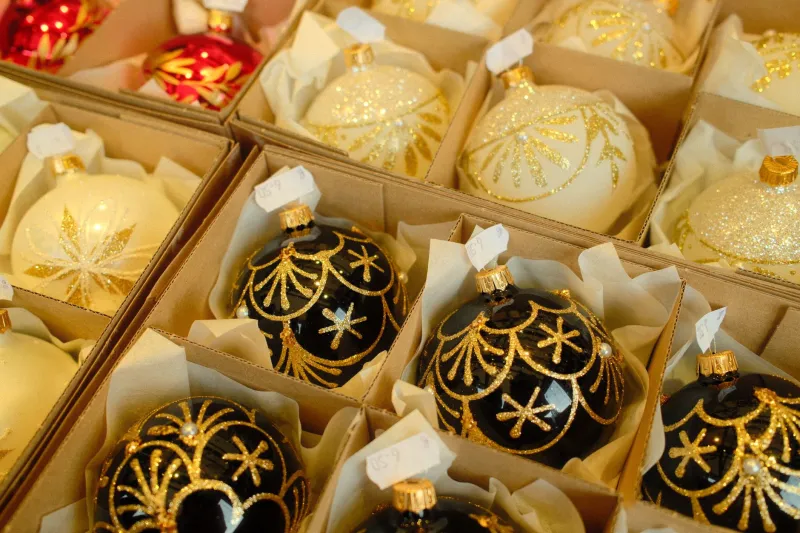
By the second week of November, the Christmas lots start appearing in UK salerooms with the reliability of advent calendars. They are rarely glamorous: a squat cardboard box, a tangle of tinsel, a few glass baubles rolling about like loose marbles, and a handwritten lot label that says something like “Christmas decorations, qty”. The estimate is often £10–20, and the room is half-full of people wondering whether to bother.
I bother. Not because every box is a winner — plenty are not — but because the twelve-pound Christmas box is one of the last honest mixed lots left. Nobody has curated it. Nobody has photographed it against a hessian backdrop. It is exactly what it looks like, and that is precisely why it rewards a bit of quiet reading before the hammer falls.
The cardboard speaks first
Before you touch a single bauble, look at the box. Old Christmas decorations were sold in printed cardboard boxes, and those boxes are often more datable than the contents. A pre-war German box will usually have a lithographed lid, slightly waxy card, and lettering that mixes Gothic script with English export text. Post-war British boxes tend to be plainer: a single colour, a maker’s name such as Swan or Fairy, and a printed “Made in England” that sits somewhere between proud and apologetic.
Look for retailer names. Woolworths, Binns, Selfridges, Hamleys and a long tail of local department stores all stamped their own boxes. A box printed with a price in shillings and pence is a useful marker — it does not date the baubles precisely, but it tells you the packaging was not made yesterday. So does the typography: anything set in a chunky 1970s sans-serif is probably later than the glass inside it.
Wear matters too. A box that has been opened every December for forty years will have softened corners, a split along one flap, and faint pencil marks where someone wrote “front room” or “spare”. That is not damage; that is provenance of a very ordinary kind. A box that looks factory-fresh while containing dull, heavy glass is more likely a marriage of convenience.
Caps, collars and the crimp marks
The metal cap at the top of a bauble is the single most useful dating clue, and the one most often ignored. Early baubles — Victorian and Edwardian — usually have a brass or tinned metal cap, often quite deep, with a small wire loop that has been hand-twisted. The cap may be slightly uneven, and the crimp marks around the neck will be irregular. Later caps are shallower, thinner and more uniform: aluminium from the 1930s onwards, then painted tin, then plastic from the 1960s.
A replaced cap is not a disaster, but it is information. If a bright silver cap sits on a bauble whose glass and paint look eighty years older, someone has been repairing. Look at the wire loop: original wire is usually dull and slightly pitted, while replacement craft wire is bright and springy. Also check for rust bleeding into the glass around the collar — a common problem on damp-stored boxes, and a warning that the contents may have been sitting in a garage since the last Coronation.
One further check: turn the bauble upside down. A true early kugel — the heavy, German-made, mirror-finish bauble — will feel denser than its size suggests and often has a brass cap with a distinctive flared collar. Kugels are the quiet stars of these lots, and a single good one can justify the whole twelve pounds.
What the glass is telling you
Old baubles were blown by mouth, which means the glass is thin, slightly irregular and often has a faint pontil mark where it was snapped off the rod. Hold one up to the light: if the surface is perfectly uniform and the wall thickness is dead even, you are probably looking at a later machine-made piece. That is not automatically bad — 1950s and 1960s British baubles have their own charm — but it changes the value.
Paint is the next giveaway. Early silvering was done with mercury or silver nitrate, and it tends to have a soft, slightly cloudy bloom rather than a hard mirror shine. Later spray-painted baubles often show a crisp edge where the colour stops, and the paint can flake in tiny, sharp-edged patches. Crazing — the fine web of cracks across the surface — is common on older glass and is not necessarily fatal, but a bauble with crazing plus a hairline crack at the neck is a bauble for the bin, not the tree.
Beware the ringer. Modern reproductions of Victorian-style baubles are everywhere, usually with a too-perfect shape, a shiny plastic cap and a price sticker from a garden centre still clinging to the base. A mixed box will often contain three genuinely old pieces and a dozen later fillers. That is fine, as long as you are paying for the three.
The arithmetic of a twelve-pound lot
At a provincial UK saleroom in late November 2026, a mixed Christmas box might carry a £10–15 estimate and sell for £12, £18, sometimes £25 if two bidders get sentimental. Add the buyer’s premium — often 20–25 per cent plus VAT — and your twelve-pound box is closer to sixteen. That is still cheap, but it is not free, and it should shape how you bid.
A useful rule of thumb: ordinary 1950s–70s glass baubles are worth £1–3 each at a fair. Decorated pieces — striped, stencilled, with applied mica or figural shapes — can reach £5–10. Early kugels and pre-war German glass can run £20–60 for a good example, more if the box is original and complete. A full, boxed set of six matching baubles in good condition is worth more than the sum of its parts, because matching sets are rarer than singletons.
So the question is not “is this box nice?” but “how many pieces in here would I actually pay for individually?” If the answer is three or more, and none of them are cracked, the twelve pounds is probably sensible. If the answer is one, and it is a common red bauble with a replacement cap, walk away.
A short checklist before the hammer
Look at the box printing and wear. Check the caps for age, corrosion and replacement wire. Hold the glass to the light for pontil marks, even walls and paint bloom. Separate the old from the later fillers. Count the pieces you would genuinely buy on their own. Then decide.
And if you do buy the box, do not throw the cardboard away. In twenty years, the box will be half the story — and the baubles will still be hanging there, slightly crooked, waiting for someone to read them.